Few days ago I wrote a blog on Business Objects as an SAP Company, and described their future plan on Crystal Report product. I emphasized on BI module integration with Crystal Report. Now, they officially published the forward-looking statements which describes it only product for report designing. Currently, It is working parallel with BEx Report Designer. But very soon, Crystal Report would be only solutions for report designing.
Here is more detail view in pictorial form,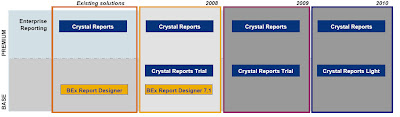
Showing posts with label SAP. Show all posts
Showing posts with label SAP. Show all posts
Sunday, February 17, 2008
Crystal Report and BI


Monday, February 11, 2008
BusinessObjects as an SAP Company
Transforming the way the world works by connecting people, information and businesses
You all heard about Crystal Reports and Business Objects. Now, It is a part of SAP AG. I'm seeing this tool as an integral and important component in SAP NetWeaver BI 7.0.
It will change whole scenario of reporting and optimize with other module of SAP.
It could encourage non-SAP companies to implement BI 7.0. Most of the old crystal report developer, who are not fimiliar with BEx Analyzer, Now easily shift to SAP reporting.
Saturday, February 9, 2008
Visual Composer
It is my first experience to deliver lecture in front of audience. My friend announced my name for Visual Composer and I was not ready. Meanwhile, I managed by myself because earlier I had done some research on it. During VC session I faced some challenging question that flunked my mind. I just enlisted the key points regarding question and then provided my analysis on it.
I know most of you don't know about Visual Composer. It is new tool for SAP Enterprise portal and used to desing interactive web pages with database connection. While, RFC and ABAP worked on backend side.
Saturday, February 2, 2008
Process Chain Architecture
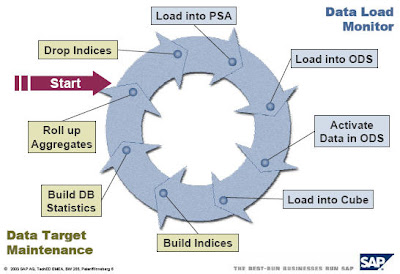
You had read my earlier post on Data Flow in SAP Netweaver BI 7.0. If you notice the diagram on the right hand side, you will find Process Chain label. Actually, It automate and schedule the whole data flow process. Following diagram show typical data load cycle. It will help to design Process Chain.
Saturday, January 26, 2008
Data Flow in SAP NetWeaver 7.0
Yes. I like this graphic. Because, it contains a lot of information. It depict overall data flow from source system to target system.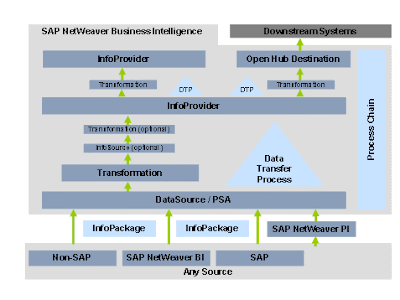
I'm waiting for your comments.
Monday, November 19, 2007
Which SAP Skill is More in Demand, BW/BI or ABAP?
June 4th, 2007
This is not even a close question at this point. BW/BI is much more in demand than ABAP. In this comparision, BW/BI is the DVD player, and ABAP is the VHS video tape.That may not be totally fair, I guess, because SAP is including full support for ABAP in the NetWeaver 2004s technology platform. Essentially SAP has figured out how to “wrap” ABAP in web-based integration protocols, and that has extended ABAP’s lifespan dramatically while keeping ABAP more in the spotlight than it would have been.
So if that’s true, then where do I get off saying that BW/BI is in much more demand than ABAP? To understand the consulting market, we have to look at every source of supply for a particular skill set. Yes, there are a lot of ABAP projects out there, but remember, ABAP is the most commonly outsourced SAP project area.
The thing about offshoring is that it increases the overall supply of consultants, since the pool for consultants is effectively globalized. Demand for ABAP then goes down. It may be unfair to say that ABAP is “dead.” A better way of putting it is that ABAP is globalized. That’s what’s hurting ABAP rates the most. Yes, there is room on project sites for top notch ABAP-Java “hybrid” programmers who can really make the latest SAP tools hum. But for the most part, ABAP demand is flat and so are rates.
BI, on the other hand, is one of the hottest areas of SAP. What are the reasons for this? First, the usage of BW is more and more common across SAP projects, so the demand is high. When we consider that as of NetWeaver 2004s, SAP BI (the new name for BW) ships with the core NetWeaver platform, usage of BI is just going to increase. So, the demand for BI is high and looks to remain so as the upgrade waves continue.
And here’s the other thing: the supply of Business Intelligence (BI) consultants is not what it needs to be. As consultants have learned the hard way, most companies won’t hire you unless you have worked in the latest releases. And there aren’t that many consultants who have been through a BI 7.0 implementation yet. So anyone who can get the BI 7.0 skills first should have an edge - especially if they have a deep BW background.
The ideal way to succeed in SAP is always to combine a deeper expertise with relevant, project-proven skills in something hot and new (such as BI). I’m not as skeptical on the future of ABAP as some, but when ABAP goes head-to-head with BI, there’s no competition at all. BI is without question the better career path.
Reference: http://www.jonerp.com/component/option,com_jd-wp/Itemid,20/p,5/
Tuesday, November 6, 2007
SAP BW/BI Extended Star Schema
Could you believe how SAP use the surrogate key concept in its Extended Star Schema Model.
Before, I explain this concept. I would like to say some basic design information about model.
This model have only one Fact Table and and few dimensions (maximum 16, among them 3 dimensions are predefined.).
Each dimension has one or more characteristics(It could be simple object or Master Data (attribute, text, hierarchy)). But these characteristic is referenced by SID.
The characteristic values are not stored in the dimension tables. A numerical SID key is generated for each characteristic. This foreign key replaces the characteristic as the component of the dimension table.
SID table is separetly maintained and primary key of this table comes from characteristic table.
Its mean SID take cares to each characteristic, and if any characteristic contain master data then those characteristics could be independently used by any dimension to avoid replication of master data. This is the great advantage of SID in Extended Star Schema.
Fact Table contain key figures (fact, numerical values) and dimensions ids as foreign key.
And fact table and dimension are connected relationally, and form Info Cube.
I think, this is very interesting post and I m waiting for your question.
Subscribe to:
Posts (Atom)
